
 Written by
 Support CleanTechnica’s work through a Substack subscription or on Stripe.
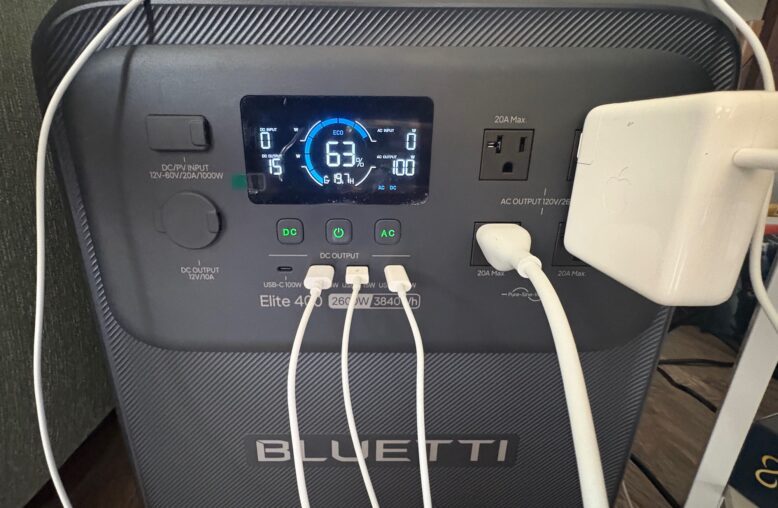
Zachary Shahan’s review of the Bluetti Elite 400 battery made me smile, I have to admit. Let me explain. Perhaps you might smile as well.
I have been interested in getting a solar power system for a very long time. So long, in fact, that I remember talking about such a thing with friends several times when I was in college. That means before 1970. I knew I was most likely to live in New England, and at that time, it was not really something to include in plans.
In about 1990, I could see the time might be coming to get a solar system. A series of events took place in my life. First of all, I went through a time when I had big power outages in my life. I was living on a peninsula in Plymouth Bay in Massachusetts when Hurricane Bob hit in August of 1991, and I was there when the Perfect Storm hit in late October of the same year. Both storms cut off my electric power for over a week.
That brought the ideas of solar photovoltaics (PV) back into my mind. I was not sufficiently flush to be able to buy them right off, but they were on my mind.
In 1997, I was living near the top of a small mountain in New Hampshire. At one time, there were three inches of snow predicted, but eight fell. The next day, I heard on my car radio that another three inches were expected. I looked at the branches of trees bending over the road, making it feel like a tunnel, and I thought, “If this three inches is anything like last night’s, we may be in trouble.”
I stopped at the local hardware store and bought a small generator and a five-gallon gasoline container. Then I stopped at the gas station and went home. That was the year of the April Fool’s Blizzard. We went without electricity for over a week.
The next year, in January, we were hit by an ice storm. Once more, we went without power for over a week.
I loved the generator for its ability to keep us powered. We had an oil furnace, and we could keep both that and the refrigerator going for about twelve hours per day. But you might say the generator and I had a love–hate relationship. I hated it for its noise and fumes. I had it shut down at night for about twelve hours. It was slightly unpleasant to get up in a house that was at about 50° each morning. It was very unpleasant to put up with the constant noise and the fumes that inevitably got into the house when the wind shifted.
In 2004, I moved to Vermont. By about 2015, I had bought a small PV system, about 2 kilowatts. In those days, batteries were still out of the question for me, because they were too expensive. I wished for them, but I couldn’t get any installed.
I don’t remember when I first saw a CleanTechnica review of a small battery system. It might have be a Bluetti system, about four years ago. Other systems were reviewed after that. I paid attention when a Jackery battery system appeared a couple of years ago. I paid attention more with passing time, and the more I saw, the curiouser I got.
Last September, Kyle Field did a review of the Anker SOLIX C1000 Gen 2 Portable Power Station. When I read that, I knew it was time to do some serious research. Prices were getting within reach. And after a bit of that, I decided to buy two batteries. Two, because they were not going to be installed to provide power to the wall outlets, and the loads they were to support would not be very near each other.
I spent time looking at systems I had recently seen posted on CleanTechnica. In terms of specifications and costs, the various systems available were very similar. The differences were enough to warrant comparisons, and that took time. I decided to go with Anker Solix, though I might have felt as good buying from Jackery or Bluetti.
One of the first things I learned about Anker Solix is that their tech support seems eager to help. The main issue I brought up was a question of whether a solar panel I had could be used to power a C1000.
The C1000 specifications said it should not be hooked up to a solar panel of 60 volts or more. Since my panels produce less than 60 volts when they are in use, but they are at 60 volts when the sun is shining and they have no load, I asked specifically about that. I was told the voltage was too high, even if the battery was not charging. To use the panels I had, I would need to get the F3000 battery, F3800 battery, or a larger battery.
At about that time, I was contacted by a neighbor who runs a deconstruction service to see if I was interested in buying used solar panels. These would power the C1000 batteries easily. They were 50-watt panels, and I could buy them for $20 each.
I looked to where the batteries would be installed in an outage. One would support one or more computers plus lights. My main computer, with its monitor, can draw as much as 65 watts, though it usually draws 55 or less. My smaller computers draw about 15 to 18 watts. My lights are LEDs that draw from 7 watts down to less than 1 watt.
I would also have to supply electricity to the refrigerator, possibly with a microwave for brief spans. Microwaves use a lot of power, but only for short amounts of time. Refrigerators cycle on and off, usually using less power than a microwave, but more energy. (Power is in watts, energy is in watt-hours. Watt-hours are what you pay for.)
It is important also to plan a route for a cable to get from the solar panels to the batteries. These batteries, however, could be moved in a pinch to where the panels are and plugged in. Please note that this would almost certainly mean the panels would be unplugged from their array and set up for charging the batteries, a job that could be tricky if it is not planned in advance.
I decided to get one C1000 and one F3000. As it happened, a friend wanted the same combination for similar reasons, so I ordered two of each. The result of that was that I got a portable solar panel as a thank-you from Anker Solix.
I charged the F3000, and so far I have kept it in reserve. The C1000, however, is in daily use, because it can be used as a super uninterruptible power supply. It is plugged into the wall, and my computer system is plugged into it. If the grid goes down when I work before sunup, I might not even notice — except for one thing: the optical fiber system that I use to access the internet fails when there is no electricity. (I can’t change that because it is somewhere in the internet system and not in the building where I live. Maybe I should go back to copper wires. Or maybe I should suggest to the internet provider that they use a small, inexpensive battery backup system.)
I have come to the conclusion that everyone should get a battery backup system, unless they are already set to run off-grid. That means everyone without solar, who should be able to get systems to keep them going through most outages without any power input. But it is even more true for people who have solar systems without batteries.
Many people don’t know that they can’t have electricity when the grid is down if they just have solar power. It is really necessary to have battery backup also. Most people who have bought solar systems so far have not bought battery backup even if they have known about it, because it was expensive to buy batteries.
The really good news is that battery systems are no longer expensive. The small systems I have been talking about have built-in charge controllers and inverters. Most I have looked at can be charged from a wall outlet and solar panels at the same time. They have multiple outlets supplying good sine-wave AC power, and they have several kinds of outlets for DC power. Most can provide power from any or all at once.
These systems can provide good backup for anyone who needs backup, regardless of whether they have solar power or not.
But importantly, these systems potentially provide a way to use a solar system for backup power, even it you got a solar system in the old days, when batteries were too expensive to consider. That was then. This is now. And together, these are a new kind of battery.
Sign up for CleanTechnica’s Weekly Substack for Zach and Scott’s in-depth analyses and high level summaries, sign up for our daily newsletter, and follow us on Google News!
Have a tip for CleanTechnica? Want to advertise? Want to suggest a guest for our CleanTech Talk podcast? Contact us here.
Sign up for our daily newsletter for 15 new cleantech stories a day. Or sign up for our weekly one on top stories of the week if daily is too frequent.
CleanTechnica uses affiliate links. See our policy here.
CleanTechnica’s Comment Policy

Source link by CleanTechnica Reviews Archives
Author George Harvey
#Backup #Battery #Rest