
 Written by
Stay informed with free updates
Simply sign up to the German politics myFT Digest — delivered directly to your inbox.
Chancellor Friedrich Merz’s Christian Democrats suffered a setback in key regional elections in south-western Germany, following a late surge of support for the ruling Greens in the industrial state of Baden-Württemberg.
Merz had hoped to reclaim the 11mn-strong state — an export powerhouse home to companies such as Porsche, Mercedes-Benz, Bosch and SAP — in a major electoral test, a year after taking office as chancellor and ahead of more challenging regional elections later this year.
But the Greens, which have led coalition governments in Baden-Württemberg since 2011, narrowly secured the largest share of the vote with 30.2 per cent, down from 32.6 per cent in the previous 2021 state election. The party secured 11.6 per cent in last year’s nationwide federal elections.
Merz’s CDU, the Greens’ junior coalition partner in the state, won 29.7 per cent of the vote — an increase from 24 per cent in 2021 but a disappointment after leading opinion polls for months.
Alternative for Germany has become the third-largest political force in the state after nearly doubling its vote share to 18.8 per cent, from 9.7 per cent in the past state election.
The result underlines the far-right party’s electoral advance in western Germany, although it underperformed the roughly 25 per cent support it commands in national opinion polls.
The Social Democrats, Merz’s coalition partners at the federal level, slumped to 5.5 per cent, down from 11 per cent in 2021.
The liberal Free Democrats, which had continuously won seats in the regional parliament since 1952, failed to cross the 5 per cent threshold that allows representation.
The Baden-Württemberg polls — the first of five regional elections this year — had been seen as the most winnable and politically significant for Merz, who was elected chancellor last year on a promise to revive Germany’s stagnating economy.
Baden-Württemberg’s export-oriented companies, in particular in the automotive sector, have suffered from fierce Chinese competition and US tariffs.
The results are “not going to be a boost for Merz”, said Andreas Busch, professor of political sciences at Göttingen university. “They counted the chickens before they hatched.”
The AfD result, meanwhile, “underlines that the party has moved well beyond being an east German phenomenon”, Carsten Brzeski, global head of macro at ING, wrote in a note to clients.
“In Baden-Württemberg, the AfD’s gains are also a reflection of the structural weaknesses of an economy in painful transition: what coal and steel were to the Ruhr Valley, the combustion engine risks becoming to this state.”
The CDU previously dominated the traditionally conservative state. Manuel Hagel, its 37-year-old candidate, had for months been expected to win comfortably after long-serving Green premier Winfried Kretschmann, 77, announced he would step down. He had held office since 2011.
But support for Hagel slipped after a 2018 video resurfaced in which he appeared to make borderline sexist remarks about teenage girls.
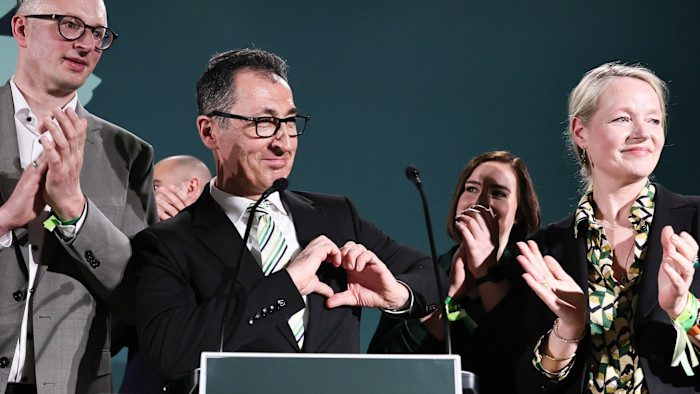
The Greens’ win leaves its candidate Cem Özdemir well placed to become the first German state premier of Turkish descent in a coalition with the CDU. Özdemir, 60, was born in Baden-Württemberg to Turkish immigrants and served as agriculture minister in the ill-fated federal coalition of Social Democratic chancellor Olaf Scholz.
Author
Source link ,